Tuesday, May 21, 2013

Praise the Lord and Pass the Ammunition

Oh oh. When congressmen start dueling with Biblical quotes we're all in trouble. A couple of days ago, listening to satellite radio, I happened to catch that old Kay Kyser World War II big band song, "Praise the Lord and Pass the Ammunition." I thought about that this morning when I read an article from NBC News on the current debate. "A heated battle is brewing on Capitol Hill over cuts to the food stamp program," said the lead, "with lawmakers quoting Bible verses at each other and benefits for millions of people hanging in the balance." You could almost see the gathering black clouds and hear the guns in the far distance. All they were missing was Edward R. Murrow.

Not to make light of this, but we're talking about finding a spending number we can all live with. This used to be pretty routine in lawmaking. A few overwrought speeches from the floor, a couple of bourbons in the cloak room, and a new highway somewhere, and there  you go. Off to the president for his signature.

Not so much anymore. In the case of the latest (emphasis on the late) Farm Bill, we're talking about the House and Senate trying to bridge a $16 billion spending gap. That's like trying to jump the Snake River Canyon with a BMX.

If you believe the Senate's version, the House proposal would expose two million people to untold misery by throwing them off the program. Or, they should never have been on the program in the first place and we don't have the money to keep them there, if you favor the House's approach. Either way, this gap has to be closed.

Sticking the SNAP budget in the Farm Bill used to make sense  because it gave lawmakers safe harbor for their other spending initiatives in the bill. Maybe that's not the case anymore. It has been suggested that given the wrangling about the Farm Bill it might be time to break out the SNAP budget from the battle over ag subsidies and fight them separately.

All I know is that when lawmakers start thinking it's their job to do the Lord's work, we're all in trouble. I think the Almighty's can handle what's on His plate. I think with a Farm Bill months overdue and a budget process that's not worthy of the name anymore lawmakers should stick to their own work and figure out a way to close this gap and get a deal done. 

Wednesday, May 8, 2013

Farmers Markets

A bill introduced earlier this year in the Florida legislature would have gone a long way towards putting some muscle behind the drive to expand SNAP EBT to farmers markets in the Sunshine State. Senate Bill 778, titled "Transactions in Fresh Produce Markets," would have required farmers market operators and managers to let third party organizations operate EBT systems in those markets. The bill apparently died in committee and is off the calendar. 

No word on whether the bill's sponsor, Sen. Geri Thompson (D-Orange County), will reintroduce.

Monday, April 29, 2013

Some Hard Data on Farmers Markets


Whether you work with government-sponsored nutrition programs like the Snap program or not, you’ve probably heard the buzz by now about farmers markets. Every spring they sprout up in vacant lots in urban areas, in Yuppie neighborhoods, or in church parking lots anywhere in America. We know where they are and what they are. What we don’t know are the business issues underlying them.

The U.S. Department of Agriculture’s Office of Research andAnalysis has shed some more light on the inner workings of these markets with a new study, “Nutrition Assistance at Farmers Markets: Understanding Current Operations.” It provides a look into how these markets operate and what makes them sustainable.

The data for the study were gathered from a national survey of nearly 1,700 markets and 600 farmers who market directly to the public.  The survey results covered into four areas:

1.       Operations
2.       Funding
3.       Products
4.       Snap participation

Operations
The study showed a gradual evolution in market operations. For example, markets that were authorized by USDA for Snap EBT and were actively accepting that form of tender were more organized and tended to have more rules regarding market participation.

These markets also tended to partner with some other types of organization. They also required the vendors to report the value of their sales, and had operating expense greater than $25,000.

Direct sellers who actively sold to Snap program participants were likely to be long-time, full-time farmers.  Nearly two-thirds of them also sold in farmers markets. And, if a farmer was currently Snap-authorized and redeeming, he was more likely to have annual farm revenue above $100,000. That farmer was also likely to see more than 25 percent of his total revenue come from direct food sales.

Funding
Despite the focus on food, both markets and direct-from-the-farm sellers rely on other sources of income, according to the survey. Over four-fifths of farmers markets rely on vendor fees. Roughly 40 percent of farmers markets and 30 percent of direct sellers got outside financial or in some cases non-financial aid. Sources of this aid included non-federal government agencies, non-profit agencies or private businesses.

The Cooperative Extension Service was the largest provider of aid to direct-marketing farmers.

Products
Both farmers markets and direct-from-the-farm sellers sold more fruits and vegetables than any other product. However, direct-selling farmers were less likely than markets to feature other products, according to the survey.

Snap Participation and Barriers to Participation
When an entire markets not authorized to accept Snap benefits it is still likely that some of the vendors in the market are Snap-approved. The converse is also true, according the survey. When the market is Snap-authorized, there may be some vendors within the market that do not participate in the program, according to the study.

Lack of infrastructure was the factor most cited by non-participating sellers and the reason for not participating in the Snap program.  Infrastructure could include a “card-accepting device,” that allows the seller to “read” the card data, or telecommunications connections that allow the seller to transmit the electronic card data for authorization.

Issues
The USDA survey is a valuable tool for understanding the business and operational issues of farmers markets. But questions remain, such as: Exactly how viable a business is farmers market? Is it sustainable for the long run? Could it survive without the subsidies and grants that 40 percent of markets and 30 percent of direct marketing farmers receive, according to the data?

And if the answer to the survivability question is no, then rather than looking market business models, we should examine whether there is a compelling public interest that underlies farmers markets. If the answer to that question is yes, then perhaps markets should be treated as another nutrition channel, similar to the School Lunch program or WIC, and federally supported as such.

But there is even a problem with that. According to the survey, just the process alone of becoming Snap-authorized may be problematic for sellers and markets. This includes the application process, the necessary end-of-day accounting, the potential need to hire staff to deal with the paperwork and the cost of equipment.  When direct marketing farmers who redeem the most benefits only see a quarter of their sales from the government program, there’s not a big incentive for other farmers to join in.

Nutritional Assistance of Farmers Markets” is a good piece of research. But we still have a long way to go before we figure out whether farmers markets will be a viable piece to solving our nation’s nutritional puzzle, or a Saturday morning curiosity for the Starbucks crowd. 

Friday, March 29, 2013

Minimum Income?

There has been a lot of buzz generated since yesterday's article in the Wall Street Journal about the explosive growth in the SNAP, formerly food stamps, program.

Now the Daily Beast has weighed in with a story by David Frum "Are Food Stamps Becoming a De Facto Guaranteed Minimum Income?" Like the WSJ article it discusses the effect of changing income and asset tests on caseload growth.

Read it at www.thedailybeast.com.

Thursday, March 28, 2013

The Value of Electronic Benefits Transfer

EBT professionals talk among themselves about the advantages and scope of EBT. But it's nice to the work we've all done recognized by "civilians." The Fort Mill Times has a nice article on the advantages that electronic government payments, including EBT, bring to cardholders. The article recounts a recent study by the Center for Financial Services Innovation and Hudson Institute, "Double Duty: Payments Cards as a Doorway to Greater Financial Health."

 And you can read the article by clicking here.


Friday, March 1, 2013

Landmark Day in Government Payments: An Overnight Success in 17 Years

Today marks a landmark in electronic government payments. As of today, March 1, the U.S. Treasury will no longer make recurring check payments to consumers by way of those ubiquitous green checks. As of today the Treasury will only make recurring federal payments for programs like social security electronically. Consumers have the option of receiving their payments either by direct deposit or by a Direct Express card issued for that purpose.

There is a good explanation of the change in the Payment Trends portion of the Electronic Funds Transfer Association website. To access it, click here.

If you've been in this business for longer than 12 years you remember the battle over ill-fated EFT 99 program. The Debt  Collection Improvement Act of 1996 mandated that all federal payment with the exception of income tax refunds were to be made electronically by the end of the decade. By 1998 Treasury, which dubbed the new program "EFT 99") had published its final rule for how it was going to migrate millions of consumers to electronic payments.

Then the fun started.

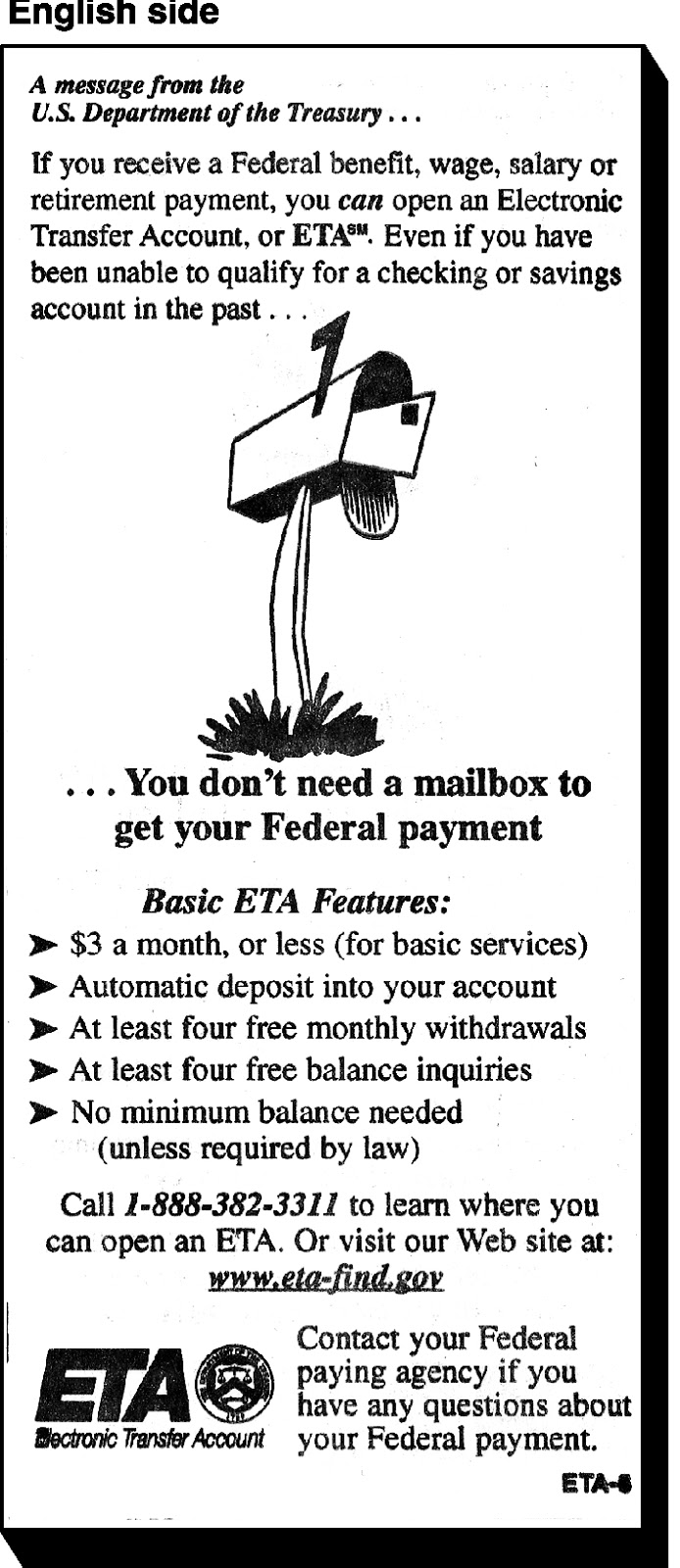
Congress, which had mandated the program, walked back it support for mandatory electronic payments in the face of withering opposition from consumer groups. Treasury announced that federal check recipients without bank accounts would receive a waiver from the electronic requirement until Treasury could develop specifications for the EFT 99 card account, which it called the Electronic Transaction Account, or ETA. The program, which according to the final rules was supposed to be mandatory, suddenly became voluntary.

Then the program got caught up in millennium politics. What was then called the General Accounting Office was required to weigh in on whether it thought EFT 99 would impact the government's Y2K remediation efforts. The program languished. By 2002 the Treasury was still disbursing a quarter of payments (excluding tax refunds) via check.
Image Courtesy of Comerica Bank

That year the House Financial Services Committee's Subcommittee on Oversight and Investigations asked the GAO to look into the issue of electronic payments. The results were not pretty. GAO concluded that the "ETA has not been widely accepted by banks or unbanked beneficiaries, despite Treasury's efforts to promote it. Since the initiation of the program in 1999 36,000 ETAs have been opened, representing fewer than 1 percent of unbanked beneficiaries..."

Despite the Herculean effort by Treasury's Financial Management Service, the ETA had bombed with the public. The conclusion of the GAO report was the final blow: "Because less than 1 percent of potential unbanked federal beneficiaries have opened ETAs, it is uncertain whether the ETA will generate enough savings sufficient to offset the cost of maintaining and promoting the program."

In other words, a program designed to save the government money was hemorrhaging cash. The program was shuttered shortly thereafter.

Fast forward to 2013. We mark today the end of a nearly 17 year effort to replace the costly, fraud-prone process of printing checks with the relatively more secure and more convenient process of government-sponsored prepaid cards.

The mistake with  EFT 99, which was in trouble from the start, was probably trying to legislate such a mandatory change in an election year. Treasury's current Direct Express program was born of an executive order and regulation and did not face the same obstacles.

However, the rapid adoption of the Direct Express card is also a measure of how far we've come in our acceptance of electronic payments in 17 years. What once made for good theater in a series of Senate hearings is now largely forgotten.

Government, in conjunction with the payments industry, continues to look at new technology for the delivery of payments. It's important for both to remember that technology acceptance isn't guaranteed. Whether it's EBT cards for the WIC program, new form factors like smart phones for transaction authorization, or mobile payments, there will be detractors, naysayers and members of the Flat Earth Society blocking the street.

But Direct Express is only the latest in a payments migration that's taken us from barter to coinage to banknotes to checks to credit to debit to mobile and beyond. What lies behind here is anybody's guess. The certainty is that we'll get there. The uncertainty is when we'll get there.


Agenda Changes

There have been some changes to the agenda for the April 10-11 eGPC meeting in Fairfax. To view the latest agenda and to register for the meeting go to  http://www.efta.org/files/pdf/efta_issue_595.pdf.