Showing posts with label EFTA. Show all posts

Friday, March 1, 2013

Landmark Day in Government Payments: An Overnight Success in 17 Years

Today marks a landmark in electronic government payments. As of today, March 1, the U.S. Treasury will no longer make recurring check payments to consumers by way of those ubiquitous green checks. As of today the Treasury will only make recurring federal payments for programs like social security electronically. Consumers have the option of receiving their payments either by direct deposit or by a Direct Express card issued for that purpose.

There is a good explanation of the change in the Payment Trends portion of the Electronic Funds Transfer Association website. To access it, click here.

If you've been in this business for longer than 12 years you remember the battle over ill-fated EFT 99 program. The Debt  Collection Improvement Act of 1996 mandated that all federal payment with the exception of income tax refunds were to be made electronically by the end of the decade. By 1998 Treasury, which dubbed the new program "EFT 99") had published its final rule for how it was going to migrate millions of consumers to electronic payments.

Then the fun started.

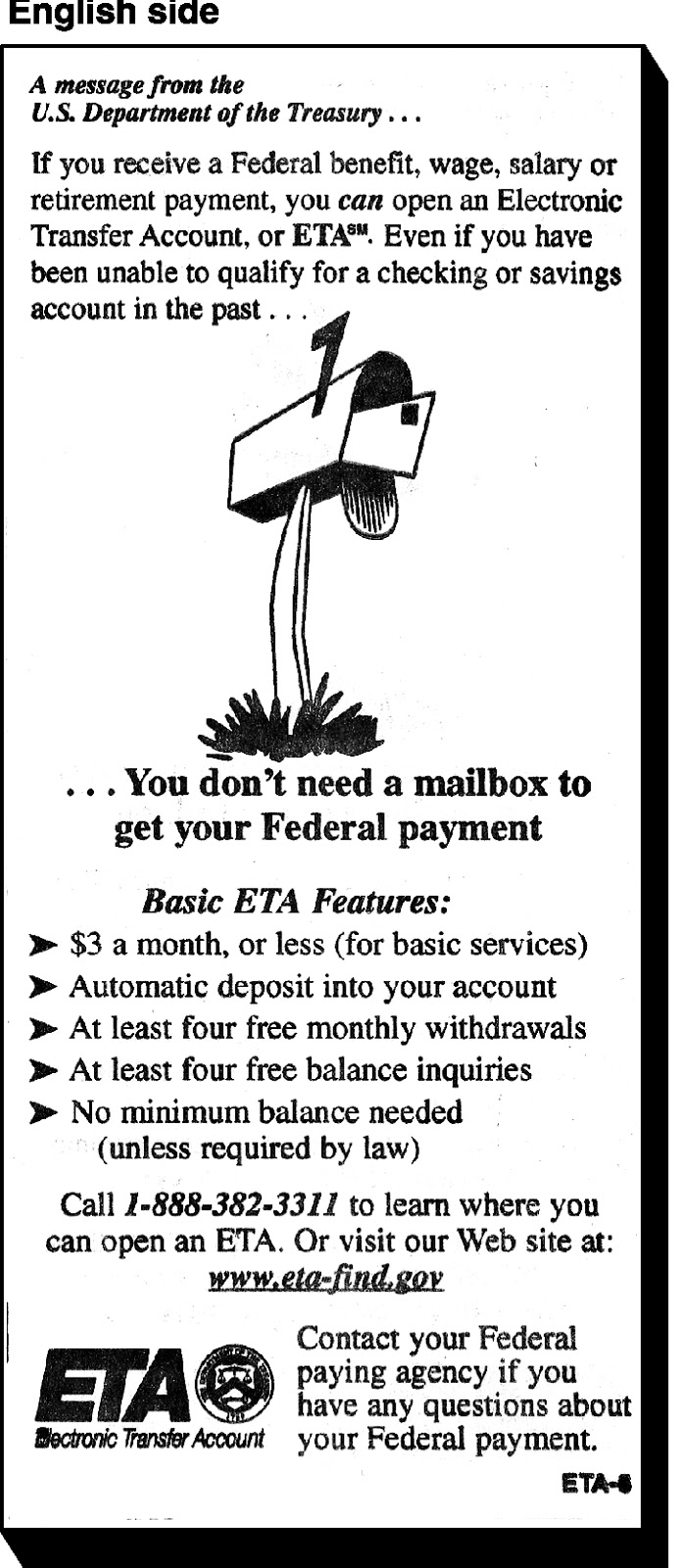
Congress, which had mandated the program, walked back it support for mandatory electronic payments in the face of withering opposition from consumer groups. Treasury announced that federal check recipients without bank accounts would receive a waiver from the electronic requirement until Treasury could develop specifications for the EFT 99 card account, which it called the Electronic Transaction Account, or ETA. The program, which according to the final rules was supposed to be mandatory, suddenly became voluntary.

Then the program got caught up in millennium politics. What was then called the General Accounting Office was required to weigh in on whether it thought EFT 99 would impact the government's Y2K remediation efforts. The program languished. By 2002 the Treasury was still disbursing a quarter of payments (excluding tax refunds) via check.
Image Courtesy of Comerica Bank

That year the House Financial Services Committee's Subcommittee on Oversight and Investigations asked the GAO to look into the issue of electronic payments. The results were not pretty. GAO concluded that the "ETA has not been widely accepted by banks or unbanked beneficiaries, despite Treasury's efforts to promote it. Since the initiation of the program in 1999 36,000 ETAs have been opened, representing fewer than 1 percent of unbanked beneficiaries..."

Despite the Herculean effort by Treasury's Financial Management Service, the ETA had bombed with the public. The conclusion of the GAO report was the final blow: "Because less than 1 percent of potential unbanked federal beneficiaries have opened ETAs, it is uncertain whether the ETA will generate enough savings sufficient to offset the cost of maintaining and promoting the program."

In other words, a program designed to save the government money was hemorrhaging cash. The program was shuttered shortly thereafter.

Fast forward to 2013. We mark today the end of a nearly 17 year effort to replace the costly, fraud-prone process of printing checks with the relatively more secure and more convenient process of government-sponsored prepaid cards.

The mistake with  EFT 99, which was in trouble from the start, was probably trying to legislate such a mandatory change in an election year. Treasury's current Direct Express program was born of an executive order and regulation and did not face the same obstacles.

However, the rapid adoption of the Direct Express card is also a measure of how far we've come in our acceptance of electronic payments in 17 years. What once made for good theater in a series of Senate hearings is now largely forgotten.

Government, in conjunction with the payments industry, continues to look at new technology for the delivery of payments. It's important for both to remember that technology acceptance isn't guaranteed. Whether it's EBT cards for the WIC program, new form factors like smart phones for transaction authorization, or mobile payments, there will be detractors, naysayers and members of the Flat Earth Society blocking the street.

But Direct Express is only the latest in a payments migration that's taken us from barter to coinage to banknotes to checks to credit to debit to mobile and beyond. What lies behind here is anybody's guess. The certainty is that we'll get there. The uncertainty is when we'll get there.


Monday, August 6, 2012

The GAO Weighs in on Restricting TANF Access


So stopping welfare recipients from getting their cash at ATMs in “vice” locations—liquor stores, casinos or strip clubs—may not be as easy as Congress thought. The Government Accountability Office has released its long-awaited report on restricting where EBT cards may be used to access Temporary Assistance for Needy Families benefits, commonly known as welfare.

Congress included the TANF restrictions in the bi-partisan Middle Class Tax Relief and Jobs Creation Act of 2012. The thinking seemed to be that because TANF is distributed in many states through electronic benefits cards that it would be easy to follow an electronic trail to see if beneficiaries were using their benefits in one of the sin sites.  One representative likened creation of this electronic trail to “throwing a switch.”

After studying the issue for half the year, the GAO isn’t so sure about that. Congress' consulting arm was pretty clear in its conclusions: 

  • There’s not enough data in that electronic trail to track a beneficiary to the liquor store
  • What data there is in that electronic trail isn’t all that accurate
  • Some of the voluntary, non-electronic methods that states use to reduce the misuse of TANF funds and other subsidies seem to work better
 The GAO report had been requested by Sen. Susan Collins (R-ME), the ranking member of the Senate Committee on Homeland Security and Governmental Affairs.

 In its conclusions the GAO tracks closely to the white paper the Electronic Funds Transfer Association and its eGovernment Payments Council issued earlier this year.

 The GAO's methodology included reviewing documentation and interviewing officials in the ten states with the highest TANF block grants in terms of dollars. Together these states represent 66 percent of all TANF block grant dollars. The GAO also obtained EBT card-transaction data from four of the ten states in order to determine whether the transaction data could be useful in developing a systemic solution for tracking where TANF funds are accessed.

 GAO concluded that EBT transactional data are "not sufficiently reliable for the purpose of performing systematic monitoring of transactions in locations that are inconsistent with the purposes of TANF.” This was one of the conclusions reached in our white paper.

 Furthermore, GAO concluded that addressing these limitations in such a way as to make transactional data a useful tool in monitoring where EBT cardholders get and use their TANF funds could require "significant resources," another conclusion of our white paper.

 GAO suggested that states consider other non-systemic methods for identifying and monitoring where TANF is accessed and used, a position EFTA and the Council have advocated for some time.

 GAO has shared its findings with the Department of Health and Human Services, which is writing regulations on state compliance with a new federal law that mandates restricting TANF access in gaming establishments, liquor stores and adult-oriented businesses. Those regulations have yet to be published.

 Since late 2011 EFTA and the Council have sought to inform the regulatory process on this issue in a number of ways. Here’s what we did:

  •  December 2011: Meeting with GAO
  • January 2012: Conducting a survey of state EBT directors on benefit restrictions
  • February 2012: Issuing our white paper on benefit restrictions
  • March 2012: Having regulators from DHSS and the principal investigators from GAO speak at our eGPC meeting in Washington
  • April 2012: Meeting again with the regulators and hosting a webinar on the regulatory process, in which the DHHS regulators participated
  • May 2012: Conducting a second survey on TANF restrictions
  • June 2012: Responding to the Department of Health and Human Services Request for Public Comment on the issue of TANF restrictions
No one is advocating that states should turn a blind eye to the diversion of benefit from their intended use of helping families get through the rough patches of life. Frankly, I think most people would be happy if there were a simple way to figure out which beneficiaries were using TANF to play the slots and which were using it to pay the rent.

TANF is a successful program because it gives states administrative flexibility to manage the program and provide a temporary lifeline to families in need. Families have to make choices about how to use a time-limited amount of money, and those choices can’t include wine, women and Keno. Whatever regulations DHHS comes up with, let’s hope they give states that administrative flexibility to come up with blocking solutions that actually, rather than theoretically, work.

If you’re interested in what GAO has to say on the subject, click here. 

Saturday, April 28, 2012

Liquor and Lap Dances: Regulating Bad Behavior

More than 100 people attended this week's EFTA webinar on complying with the new federal law that requires states to restrict access to TANF benefits in specific locations. The Middle Class Tax Relief and Jobs Creation Act of 2012, signed by Pres. Obama in February includes a section, number 4004, that requires states to prohibit TANF beneficiaries from accessing their benefits in liquor stores, gaming locations and adult-entertainment venues.

States are required by 2014 to submit a report to the Department of Health and Human Services on how they have complied with the law. States that fail to adequate comply face the loss of up to five percent of their TANF block grant.

DHHS is the federal agency that oversees the TANF program. Since the new law provides for monetary penalties, DHHS must conduct a formal rules-making process to establish regulations for complying with the intent of Congress, according to the agency.

The webinar was hosted by the Electronic Funds Transfer Association and CO-OP Financial Services. It was divided into four sections:

  1. The legislative background of the law
  2. The regulatory process that is now underway
  3. How states are complying with similar blocking state-level blocking laws
  4. Alternatives to "systemic" blocking solutions

A veteran panel discussed these four issues at length. Dennis Ambach, the senior director of government relations for EFTA, explained the origin of the bill and similar state-level movements to restrict the use of TANF. Mark Greenberg, the deputy assistant secretary for policy in the Administration for Children and Families, explained in detail the regulatory process that will produce the rules that will guide states in their compliance with the law. ACH is the branch of DHHS that administers TANF.

The EBT director for the State of Colorado, Scott Barnette, presented his state's experience in restricting access to TANF and benefits from a host of other government programs. Finally, John Simeone, executive director for JP Morgan Public Sector Prepaid Cards talked about the issues involved with trying to block access to TANF by "throwing a switch" on ATM machines. (Hint: The switch doesn't exist.)

There have been just a few seminal milestones that have marked the path of EBT. The first was creation of the first set of operating regulations in 1992. Another was Congress' willingness in the late 1990s to appropriate money so that EBT transactions could be interoperable across the country. How the Section 4004 regulations are writen will be one of those milestones.

The regulators at DHHS face a thankless task in trying to control access to TANF. Most Americans share Congress' disgust with knowing that money that was appropriated to clothe poor children and keep a roof over their heads is going instead to pay for liquor and lap dances. But implementing the law will be tricky. Compliance costs may in the end exceed the amount of money that is currently being diverted to spirits, slots and strippers.

So DHHS will have to balance such factors as cost and benefit, access and fees, and the carrot and stick of enforcement.

Here are just three of the issues that regulators will have to consider over the next several months:

Whether systemic solutions are cost effective. Results in two states have shown that the amount of TANF benefits flowing through proscribed categories of merchant is in each case less than one-half of one percent of the total amount of benefits distributed. Human services agencies have no regulatory authority over alcohol retailers, gaming or adult entertainment. In at least one state, staff time was devoted to scanning Yellow Pages to make lists of liquor stores and strip clubs to contact directly. The manpower required to implement the law could be staggering.

Whether regulations may end up reducing access for all beneficiaries. Even when a state is able to locate and contact business owners who agree to block acceptance of EBT cards at ATMs in those locations, it's not the end of the story. ATMs are mobile assets. An ATM may be replaced by one whose terminal ID has not been blocked. Or a terminal with a blocked ID may end up in a lawful location where beneficiaries may be blocked from using it.

And in remote areas of the country, for example, western states in the lower 48 and Alaska, there are places where a prohibited location may be the only location within 50 or 100 miles of where a beneficiary lives. Prohibiting that location may place an undue hardship on the beneficiary.

And what about Indian casinos? Recognized Indian nations and tribal authorities under the Indian Gaming Regulatory Act of 1988 control gaming within their territory. So the requirements of Section 4004 of the new law might not be enforceable in Indian casinos. This could cause the regulations to be applied in a discriminatory manner. One beneficiary may face a 25-mile drive to an ATM because a casino is now off limits for benefit access, while another beneficiary may hop on the Interstate, get off at the next exit and pull into an Indian casino with her EBT card.

Regulators are concerned about access costs. But we know that cost and access are code words for supply and demand. ATM owners in some areas may find that blocking these transactions may make it economically unfeasible to keep their machines in those locations. They may redeploy their machines to more profitable locations. As the supply of ATMs diminishes, will the owners of remaining machines raise their surcharges? If so, compliance with the law will result in less access and higher cost for all beneficiaries. As the supply of access points decreases, the cost of remaining access points increases.

Fairness of sanctions. States that fail to comply with the law could be sanctioned with the loss of up to five percent of their TANF block grant. But whom does this affect? Not the liquor store owner who sold a pint of bar whiskey to someone who paid with TANF funds. Not the casino owner who knowingly allowed access to TANF funds so that in three hands of blackjack the beneficiary's family support money was in his till. Not the stripper who steps off the bar with TANF cash in the waistband of her G-string.

Section 4004 sactions could end up harming the vast majority of program beneficiaries who play by the rules. A sanctioned state will be forced to make up the five percent reduction in its TANF grant by cutting other programs to use that money to meet its TANF obligation. Which programs? Maybe reduce the hours for school nurses. Maybe buy fewer assisted living devices for the disabled. Or maybe layoff the interpreters at the blind commission. Who knows?

Sanctions should not end up indirectly harming beneficiaries who play by the rules. States should comply with the new federal law by passing their own legislation that will allow them to better enforce how and where these benefits are accessed and spent. Gaming commissions should be responsible for making sure that the casinos, bingo-halls and poker clubs they oversee don't allow TANF funds to be accessed in those locations. If these businesses circumvent the gaming commission's regulations the businesses could face loss of their licenses. The same for liquor stores.

Congress did the right thing by trying to turn the focus on TANF benefits back to children and families. But regulators will have to have the leadership of Moses, the wisdom of Solomon and the patience of Job to get this one right.

DHHS will have to absorb a great deal of information in a very short period of time in order to craft regulations that don't negative impact anyone but the bad actors. And states, in their compliance plans, will have to show that they can apply the proper pressure to those bad actors in order to regulate access to and use of TANF in the manner Congress intended when it created the program.


Tuesday, March 20, 2012

Analyzing the Legislative Language of TANF Transaction Blocking

Section 4004 of the Middle Class Tax Relief  and Job Creation Act of 2012 requires state agencies to block somehow the use of EBT cards for accesssing TANF benefits in liquor stores, casinos and adult entertainment businesses.

In an interview at a recent meeting of the Electronic Funds TransferAssociation Board of Directors Dennis Ambach, EFTA legislative director, analyzes the language of the bill and what it might mean for states.

Dennis Ambach is the Legislative Director of
the Electronic Funds Transfer Association and
explains the legislative requirements of
Section 4004 of the Middle Class Tax Relief
and Job Creation Act of 2012


Tuesday, January 31, 2012

Welcome to the e-Government Payments Council


The e-Government Payments Council (eGPC) is an association of professionals engaged in the planning, design, development and management of electronic payment systems that issue government benefits or payments.


eGPC members are drawn from every facet of the payments industry. They include both public and private sector organizations. Within these sectors members include state program managers, consultants, processing companies, manufacturers and technology companies.


The eGPC was formed in 2008 through the merger of similar professional groups that operated under the auspices of the Electronic Funds Transfer Association (EFTA) and NACHA-The Electronic Payments Association. However the roots of the eGPC go back to 1988 and the Electronic Benefits Transfer Special Interest Group established by EFTA to support the conversion of entitlement benefits from coupons and checks to debit cards.


Today, eGPC member organizations deliver and account for billions of dollars in government-sponsored payments and benefits each month. These include the benefits formerly called food stamps, a variety of cash assistance payments, child care payments and the supplemental nutrition program known as WIC. They also include child-support enforcement payments and unemployment compensation delivered through nationally branded prepaid debit cards.


eGPC is a volunteer organization that promotes expertise, collaboration, and inclusion in order to promote excellence and professional growth in its members. It offers a variety of educational and networking opportunities for members including regularly scheduled business meetings, frequent industry updates, a newsletter and, since 1998, an annual conference.

eGPC offers multiple opportunities for membership. For information or to enroll as a member of the oldest professional group for government electronic payment professionals click here.